
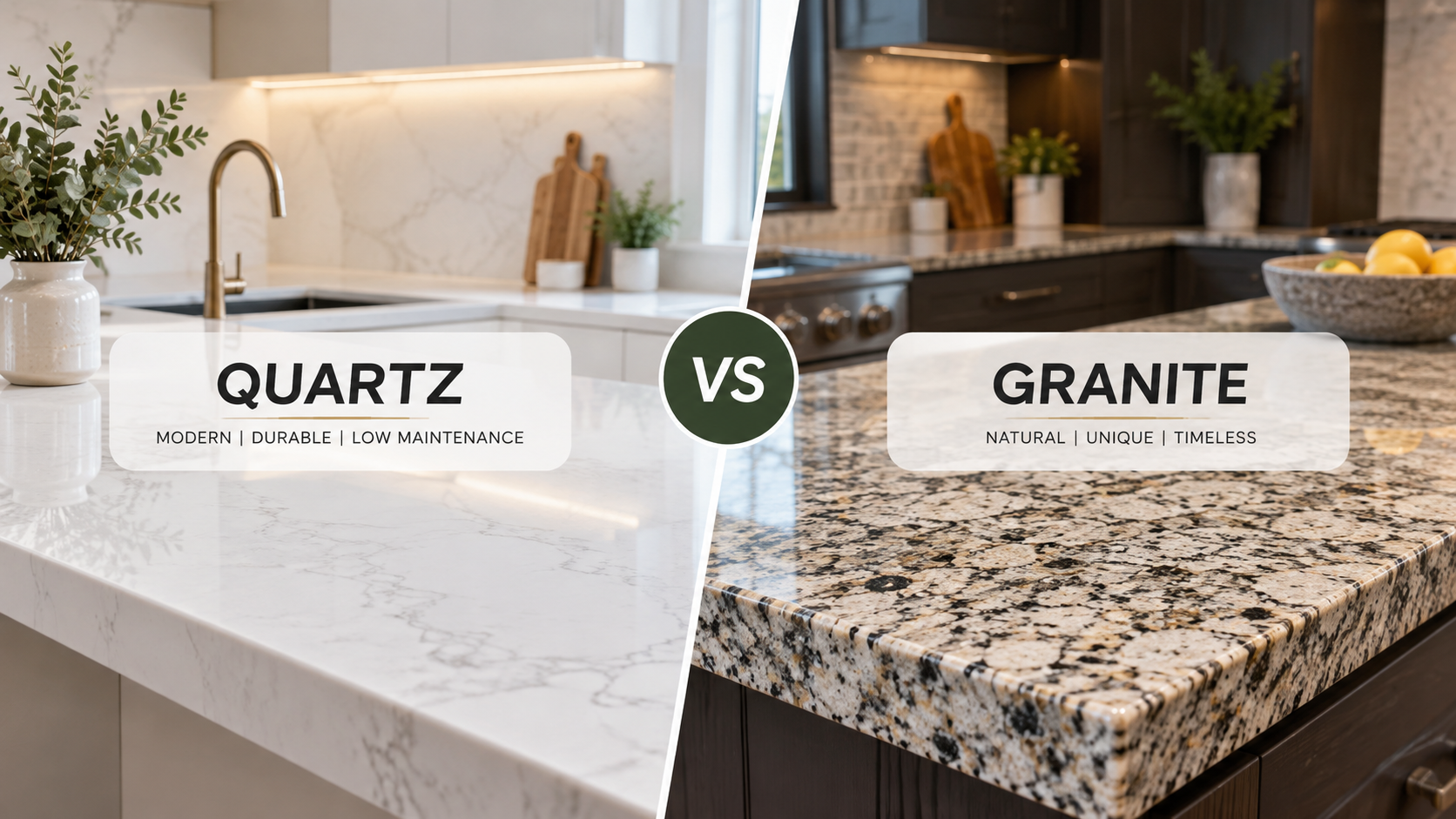
Choosing between quartz and granite usually comes down to one question: do you want a material nature made, or one engineered to behave a certain way? Both hold up well in a kitchen, both come in a wide range of colors, and both cost roughly the same to install. The real differences show up in how they’re made, how they wear over time, and how much upkeep they ask of you.
Here’s what actually separates the two, so you can pick the one that fits your home instead of guessing. If you already know you want expert eyes on your specific kitchen, you can reach out to our team and skip straight to a quote.

What Is Quartz?
Quartz countertops are engineered, not quarried. Manufacturers grind natural quartz crystal, one of the hardest minerals available, into small particles and bind it with resin under heat and pressure. The result is roughly 90 to 94 percent quartz mineral, with the rest made up of resins and pigments that control color and pattern.
Because the manufacturing process controls the final look, quartz slabs come out consistent. Order a slab in a given color and pattern today, and a second slab ordered next year will match closely. That consistency is one reason quartz has become the default choice for kitchens where a uniform look matters, like large islands or wall-to-wall counters.
What Is Granite?
Granite is quarried stone, cut directly from the earth and polished into slabs. It forms over thousands of years as magma cools slowly underground, which is why every slab carries its own mix of minerals, veining, and color variation. No two granite slabs are identical, even when they’re cut from the same block.
That natural variation is part of granite’s appeal. Homeowners who want a countertop that looks like it belongs to a specific piece of earth, rather than a repeatable pattern, tend to gravitate toward granite. It also means you’ll want to see the actual slab before it’s cut, since photos and samples rarely capture the full range of movement in the stone.
Durability: How Each Material Holds Up
Granite is naturally hard and scratch-resistant, but it’s porous. Left unsealed, it can absorb oils, wine, and other liquids, which leads to staining over time. Most granite countertops need to be sealed once a year to keep that porosity in check.
Quartz doesn’t have that problem. The resin binder makes it non-porous straight out of the factory, so it resists staining without any sealing at all. It’s also more resistant to chipping along the edges, since the engineered structure is more uniform than natural stone.
Where granite pulls ahead is heat resistance. Because it’s solid mineral, granite can handle a hot pan set directly on the surface without damage. Quartz can discolor or crack under sustained high heat, since the resin binder isn’t rated for the same temperatures. Trivets and hot pads are recommended for quartz, even though the material handles daily kitchen use well otherwise.
Maintenance: Sealing vs. Wiping Down
This is where the gap between the two materials is widest.
Granite needs annual sealing to stay stain-resistant, along with pH-neutral cleaners to avoid breaking down the sealant early. Skip the sealing schedule for a year or two, and the stone becomes more vulnerable to absorbing spills.
Quartz asks for none of that. Soap and water, or a standard kitchen cleaner, keeps it looking new. There’s no sealant to reapply and no schedule to track. For a busy kitchen, that difference alone often decides the choice.
Not sure which material fits your routine?
Tell us how you use your kitchen and we’ll help you weigh maintenance against the look you want.
Appearance: Uniform Pattern vs. Natural Variation
Granite’s pattern comes from geology, so the movement, speckling, and color shifts across a slab are one-of-a-kind. Popular colors range from black and gray to warm browns, golds, and blues, depending on where the stone was quarried.
Quartz manufacturers can replicate that natural look, including marble-style veining, but they can also produce solid colors and consistent patterns that no natural stone offers. If you’re matching a specific design scheme or want every square foot of a large island to look identical, quartz makes that easier to control.
Cost: How the Two Compare
Pricing for both materials overlaps more than most homeowners expect. Mid-range granite and mid-range quartz land in a similar price bracket per square foot installed, with the final number driven more by the specific color, slab grade, and edge profile than by the material category itself.
Rare granite colors and premium quartz brands can both push toward the higher end of the market, while entry-level options in either material bring the cost down. Getting quotes on the specific slabs or lines you’re considering, backed by our team’s 20-plus years of stonework experience, is a more reliable way to compare cost than treating “quartz” or “granite” as a fixed price point.
Which One Is Right for Your Kitchen?
Granite is a strong fit if you want a natural material with heat resistance near the cooktop and don’t mind an annual sealing routine. It’s also the better pick if you want a countertop with genuine, one-of-a-kind variation from slab to slab.
Quartz fits kitchens where low maintenance matters more than natural variation or where a large, uniform surface needs to look the same across every section. It’s also a practical choice for households that want strong stain resistance without a sealing schedule to manage.
Neither material is the wrong choice. The decision usually comes down to how much upkeep you want to take on and how important natural variation is to the look you’re going for. Reach out to our team with your kitchen layout and style, and we can walk you through which slabs make sense for your space, or browse our gallery to see finished quartz and granite installations. You can also read more about how we fabricate and install countertops from template to final polish.
Ready to compare slabs in person?
Bring us your kitchen layout and style, and we’ll help you figure out which stone fits your space and your budget.
Frequently Asked Questions
Is quartz or granite more durable?
Quartz resists chipping and staining better day-to-day because it’s non-porous, but granite handles direct heat better since it’s solid natural stone. Both hold up well under normal kitchen use with proper maintenance.
Does granite need to be sealed every year?
Most granite countertops need resealing about once a year to maintain stain resistance, since the stone is naturally porous. Quartz doesn’t require sealing at all.
Is quartz more expensive than granite?
Not necessarily. Pricing depends more on the specific color and slab grade than on whether the material is quartz or granite. Mid-range options in both materials typically fall in a similar price range.
Can you put a hot pot directly on quartz?
No, quartz can discolor or crack under sustained high heat because of its resin binder, so trivets and hot pads are the safer choice. Granite tolerates direct heat better.
Which material looks more natural, quartz or granite?
Granite has genuine natural variation since every slab is cut from real stone. Quartz can replicate that look through manufactured patterns, but each slab of a given quartz color and pattern will look nearly identical to the next.
Do quartz and granite countertops add the same value to a home?
Both are considered premium countertop materials and tend to have a similar effect on resale value. Buyers generally view them as an upgrade over laminate or tile, with the final impact depending more on installation quality and kitchen condition than on the specific material.
